what type of map would you use to locate the countries of the world?
Boston public schools recently announced that they will shift to using world maps based on the Peters projection, reportedly the starting time time a The states public school district has done then. Why? Considering the Peters projection accurately shows different countries' relative sizes. Although it distorts countries' shapes, this manner of drawing a world map avoids exaggerating the size of developed nations in Europe and North America and reducing the size of less adult countries in Asia, Africa and South America.
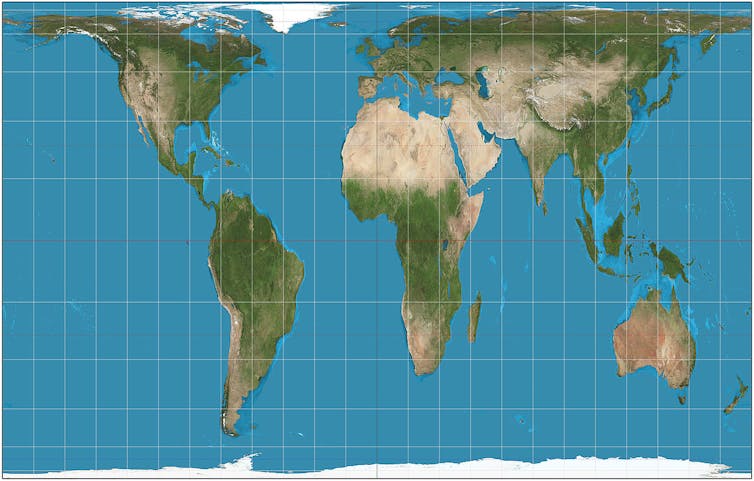
This is what happens with the more commonly used Mercator projection, which exaggerates the size of the Earth around the poles and shrinks it effectually the equator. So the developed "global North" appears bigger than reality, and equatorial regions, which tend to be less developed, appear smaller. It's specially problematic given that the kickoff world maps based on the Mercator projection were produced by European colonialists.
Why does this problem occur? Simply put, the world is round and a map is flat. Imagine drawing a earth map on an orange, peeling the skin to go out a single piece and then flattening it. It would, of course, rip. Simply imagine yous could stretch it. As yous did and then, the map drawn on its surface would distort.
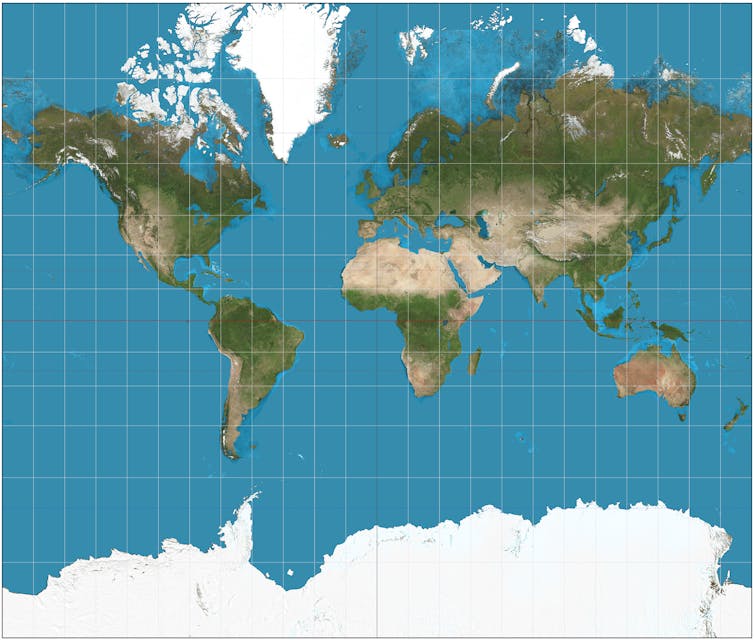
The distortions this introduces are massive. And different projections distort maps in different ways. The Mercator projection depicts Greenland as larger than Africa. But, in reality, Africa is xiv times the size of Greenland. Information technology alters the manner you see the size – and, some people argue, the fashion y'all run into the importance – of different parts of the world. So this isn't just a cartographer'southward dilemma – it'due south a political problem.
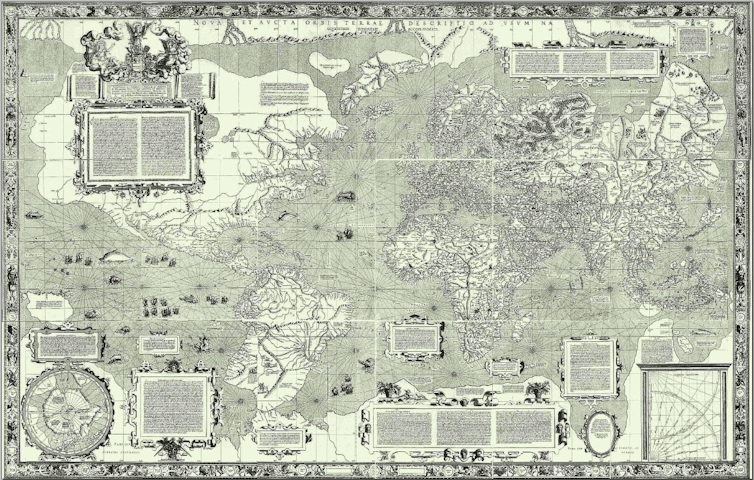
The Renaissance cartographer Gerardus Mercator did this to preserve the shapes of countries, and so the map could be used to accurately calculate compass bearings. Authentic compass bearings are very important if you are a 16th century seafarer. Only if yous want a ameliorate idea of the relative size of the world'south landmasses, you need a map that distorts shape simply preserves surface area, like the Peters projection does.
The difference between the Peters and Mercator projections shows how significant changing the way a map is drawn can exist. Here are four other map styles that each come with their own political implications.
Due south-up
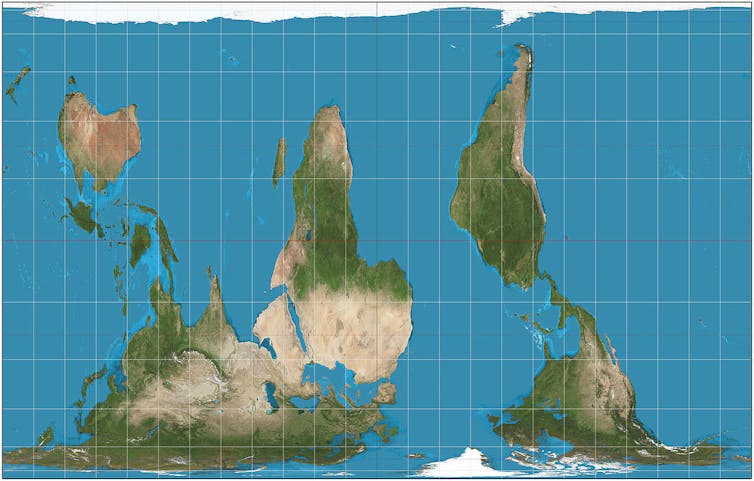
North is up, right? Only by convention. At that place's no scientific reason why due north is any more upwards than due south. Equally, we could do east-up, west-up or any other compass bearing. Purposefully reversing the typical fashion world maps are drawn has a similar political result to using the Peters projection, putting more than developing countries in the by and large poorer southern hemisphere at the top of the map and so giving them greater significance.
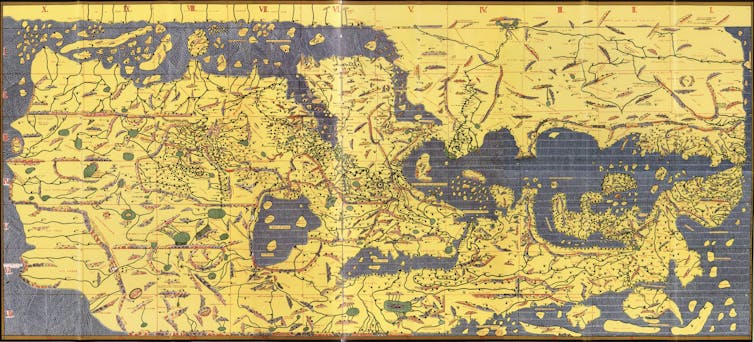
Merely some of the offset known globe maps put southward at the pinnacle every bit a matter of form. For case, in 1154 Arab geographer Muhammad al-Idrisi drew a southward-up map of Europe, Asia and northern Africa for his book the Tabula Rogeriana. The Arabian Peninsula can exist seen in the middle of the map but, of class, pointing upwards rather than the more familiar downwardly.
Pacific-centred
Another convention of world maps is that they are centred on the prime acme, or zilch degrees longitude (east-west). Merely this is scientifically arbitrary, deriving from the location of the Royal Observatory in Greenwich, London. The event is that Europe (although also Africa) is in the centre of the conventional earth map – a rather colonial perspective.
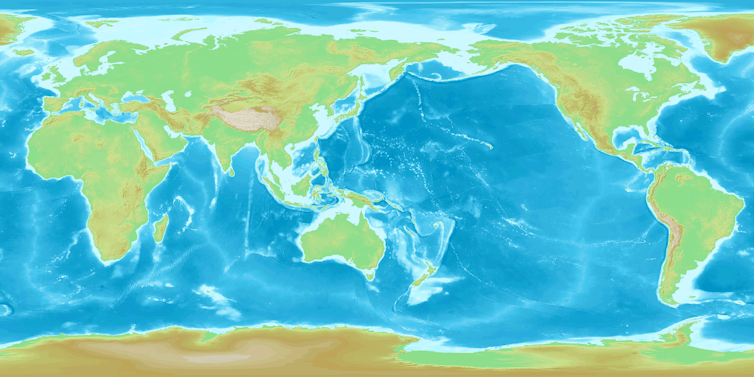
The familiar meridian-centred map conveniently places the map edges down the middle of the Pacific Bounding main so no continent is chopped in two. Just maps centred on the Pacific Body of water also work well because the edges of the map conveniently run down the eye of the Atlantic. This places eastern asia in a more than prominent position and pushes Europe to the edge. Much of Oceania and Asia uses Pacific-centred maps. (American-centred maps are also in use, but these have the unfortunate upshot of sectionalisation Asia to either side of the map.)
Our height-centred view of the globe shapes how we refer to world regions. "Far E", for instance, implies far from Greenwich, London. Seeing Europe on the left of a map and the Americas on the correct tin can seem counter-intuitive, but it is just as right equally any other arbitrary chop point. The world is, afterward all, round.
Azimuthal polar projection
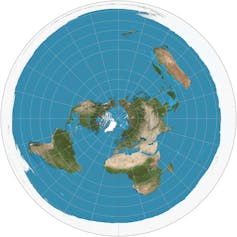
All the projections we've discussed then far tend to put one continent in the middle of the map, giving it greater prominence over the others. An alternative is to place the North Pole in the middle. Information technology is strangely disorienting to gaze on the world from a polar perspective. The lower hemisphere should be hidden from view by the bend of the Earth because you tin can merely encounter half a sphere at a fourth dimension.
Only on the azimuthal polar projection from the north, the southern hemisphere has been pulled into view on the folio, with the effect that Antarctica centrifuges into a doughnut around the border of the circular map. This highlights the disadvantage of the projection as it distorts both the area and shape of landmasses, only distances from the North Pole are authentic in all directions, with those farther from the heart becoming more than enlarged on their east-west centrality.
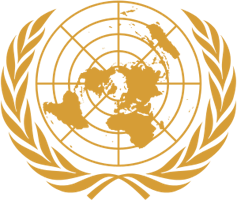
This "azimuthal" polar projection is depicted on the United Nations flag. North America was prominent on the initial 1945 UN flag (which had the longitude line xc degrees westward pointing upward). The following year, the map on the flag was reoriented to be more neutral past having the international date line (180 degrees east, lying in the center of the Pacific Bounding main) pointing upwardly. The map stops at latitude 60 degrees south, significant Antarctica does not appear.
Cartograms
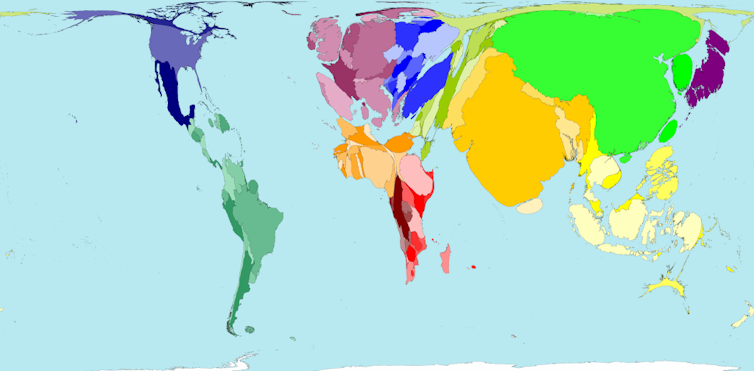
Another way of representing the globe is to display countries' sizes in proportion to key indicators of interest to geographers today, such every bit population, environment and development. Predictably, the world map of Gross domestic product is dominated past N America and Europe, while Africa about disappears. The population cartogram gives greater prominence to India and China, and makes Indonesia far bigger than neighbouring Australia. Just perhaps more surprising is the map of voter turnout, where emerging economies are bigger – and North America smaller – than many people might suppose.
Now more than ever, we need to exist able to run across the world from different perspectives. Any one perspective is not any more than correct than some other – just dissimilar.
Source: https://theconversation.com/five-maps-that-will-change-how-you-see-the-world-74967
0 Response to "what type of map would you use to locate the countries of the world?"
Post a Comment